
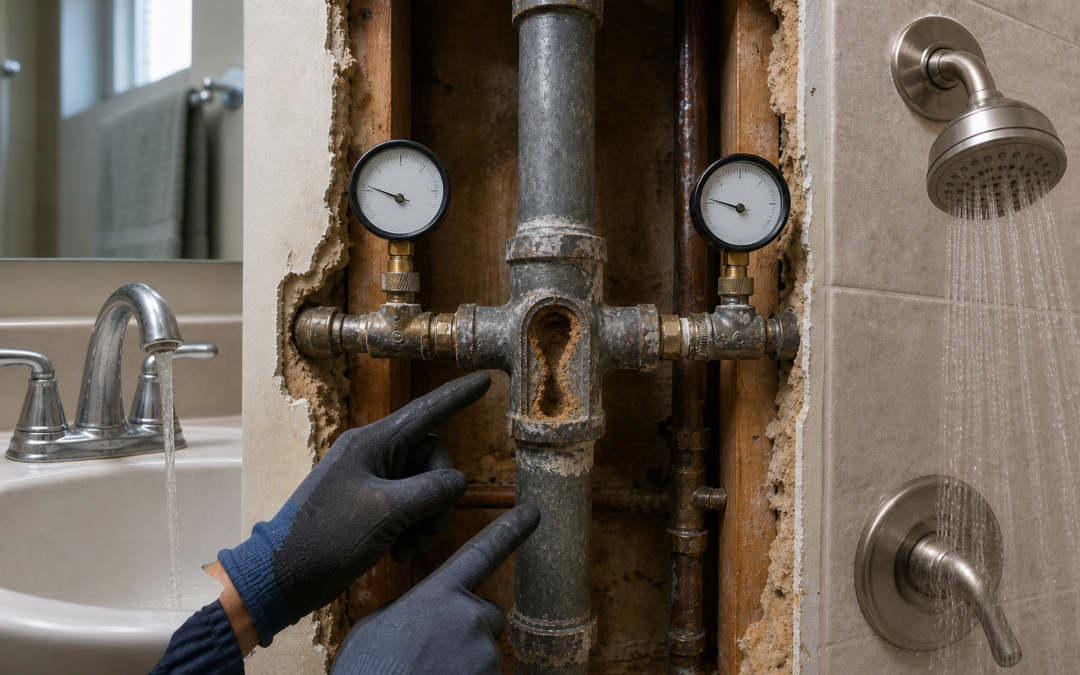
Water pressure often seems to drop when two fixtures run because both are drawing from the same available supply. If a valve, regulator, pipe, filter, or shared branch restricts that supply, the system may serve one fixture adequately but struggle when demand increases. A slight change can be normal. A drop that is new, severe, worsening, or disruptive can justify a plumbing evaluation.
The pattern matters more than the symptom alone. A weak stream at one faucet may point to that fixture. A shower that loses flow whenever a toilet refills may indicate a shared branch limitation. A change throughout the home can shift attention toward the main supply path, pressure controls, pipe condition, or another whole-system factor. None of these patterns confirms a repair by itself, but each helps narrow the next test.
Pressure and Flow Are Related but Not Identical
Homeowners often use “water pressure” to describe how strong the water feels at a faucet or showerhead. What you feel is influenced by both pressure and flow. Pressure is the force available to move water, while flow is the amount of water that can pass through the system over time.
A plumbing system can show acceptable pressure while no water is moving and still lose substantial usable pressure once fixtures open. Plumbers commonly distinguish between static pressure, measured when fixtures are off, and pressure under flow, measured while water is being used. A normal static reading does not rule out a restriction that becomes obvious only under demand.
Opening a second fixture increases the amount of water the piping must deliver. If the shared supply path has adequate capacity, the change at each outlet may be modest. If that path is narrowed, undersized for the current use, or controlled by a component that is not functioning properly, the pressure available at the fixtures can fall more noticeably.
The Fixture Pattern Helps Locate the Constraint
Write down which outlets are affected and which second fixture triggers the change. This simple comparison can help distinguish a local issue from a branch or whole-home condition without opening a wall.
One Fixture Is Weak Even When It Runs Alone
If one faucet or shower is weak by itself while other fixtures remain normal, the cause may be close to that outlet. An aerator, showerhead, cartridge, stop valve, flexible connector, or short fixture supply can restrict flow. The same fixture may become even weaker when another outlet opens, but the first clue is that it never performs normally on its own.
This pattern does not automatically point to a damaged pipe behind the wall. A plumber can compare flow before and after accessible fixture components to avoid recommending broader work for a localized restriction.
Two Fixtures on the Same Branch Affect Each Other
A shower and nearby toilet may share part of the same cold-water branch. A sink and appliance may share another section. When two fixtures connected to one branch consistently affect each other but distant outlets do not, the shared section becomes more relevant.
Possible explanations include a small branch size, an older narrowed pipe, a partially restricted valve, or a layout that was changed during earlier remodeling. The fixture pair alone cannot identify which condition exists. Pipe routing, material, diameter, valve location, and measurements under flow are needed before choosing a correction.
Many Fixture Pairs Cause a Whole-Home Drop
If almost any second fixture weakens water throughout the property, the constraint may be upstream of individual branches. The main interior shutoff, a pressure-reducing valve where one is installed, treatment equipment, the building service line, or the incoming supply may deserve review.
A plumber can compare pressure near the service entrance with readings farther into the plumbing. That comparison helps separate an incoming-supply condition from resistance inside the home. Do not force an older shutoff, operate a utility-side meter valve, or adjust a regulator to test a theory; those components can be damaged or require qualified handling.
Only Hot or Only Cold Water Is Affected
Temperature-specific symptoms add another useful distinction. If cold flow remains steady but hot flow falls sharply when two hot-water fixtures run, the shared hot-water path, accessible valves, water-heating connections, or hot-side piping may be involved. If both hot and cold outlets lose strength, the investigation may move farther upstream.
Do not dismantle or adjust a water heater or mixing component to investigate the pattern. Record whether the problem is hot-only, cold-only, or present at both temperatures and share that detail during the evaluation.
Common Reasons Simultaneous Use Exposes Low Flow
Several conditions can produce similar symptoms. The correct repair depends on measurements and the actual plumbing configuration.
A Valve or Pressure-Control Component Is Restricting Supply
A valve that is not fully open, has failed internally, or has accumulated debris can limit how much water passes under demand. A pressure-reducing valve can also contribute when its settings or internal condition no longer support stable pressure, but not every property has one.
Whole-house filters, water-treatment equipment, backflow components, and other devices in the supply path can add resistance as well. Their presence should be confirmed rather than assumed. Testing pressure before and after an accessible component can show whether the loss occurs across that point.
Pipe Size or Layout Does Not Match Current Demand
Every pipe has a practical flow capacity. Long runs, numerous fittings, elevation changes, and smaller branch lines can reduce what reaches a fixture when several outlets operate. A layout that worked for the original plumbing may feel inadequate after fixtures or rooms are added, but simultaneous-use symptoms do not prove that the entire home was piped incorrectly.
The relevant question is where the largest pressure loss occurs. A single small branch may support a focused correction. A limitation in the main distribution path requires a different discussion. Reviewing the actual route prevents a broad recommendation based only on the number of fixtures.
Corrosion or Mineral Buildup Has Narrowed Older Pipe
Galvanized steel can corrode internally over time, reducing the open diameter even when the outside looks intact. Mineral deposits can also restrict some fittings, valves, and pipe sections. The resulting passage may deliver enough water for one outlet but become a bottleneck when a second fixture opens.
Rust-colored water, recurring restrictions, visible galvanized piping, or inconsistent flow across several branches may add context, but none proves the condition of concealed pipe. An evaluation of the accessible material and pressure loss can show whether targeted pipe repair and repiping should be considered.
A Leak Is Using Part of the Available Supply
A concealed supply leak can consume water and reduce what remains available to fixtures. It may also cause unexplained water use, moisture, staining, sounds of running water, or a sudden change in system behavior. Low flow during simultaneous use alone is not proof of a leak.
If moisture or unexplained use accompanies the pressure change, professional leak detection can compare multiple observations before anyone recommends access or repair. Avoid cutting into a wall or floor based only on where the pressure seems weakest.
The Incoming Supply Changes Under Demand
Conditions outside the interior plumbing can affect available pressure. Building-supply configuration, shared service demand, utility work, or an incoming service limitation may change what reaches the home. Time-of-day patterns can be useful, but they do not identify responsibility by themselves.
Measurements at appropriate points can show whether the pressure loss is already present near the building entrance or develops farther downstream. That evidence helps direct the next conversation without replacing a plumbing inspection with guesswork.
Safe Observations to Make Before Scheduling Service
You can gather useful information without opening pipes or adjusting controls. Use fixtures normally and stop any comparison that creates overflow, active leakage, or another unsafe condition.
Record:
- Which fixture feels weak when used alone.
- Which second fixture causes the largest change.
- Whether the affected fixtures are near each other or in different parts of the home.
- Whether the change affects hot water, cold water, or both.
- Whether the condition is constant, time-dependent, or newly worse.
- Whether a toilet refill, washing-machine cycle, dishwasher, irrigation use, or shower reliably triggers it.
- Any moisture, staining, unusual water sound, rust-colored water, or unexplained change in water use.
- Any known plumbing renovation, repiping, treatment equipment, or recent utility work.
Do not repeatedly run every outlet at once to make the symptom more dramatic. Do not force a stiff shutoff, change a regulator setting, remove water-heating components, or operate the valve at the utility meter. A short, controlled observation of the normal problem is more useful than a risky home test.
E.T. Plumbing’s broader plumbing services include the systems that may need to be compared when the symptom crosses fixture, branch, and supply boundaries.
What a Plumber May Check
An evaluation may begin by confirming the symptom with one fixture and then a second fixture while measuring pressure at selected points. Comparing static pressure with pressure under controlled flow can reveal whether the system loses more pressure than expected as demand rises.
Depending on the property, the plumber may also:
- Compare an affected outlet with fixtures on other branches.
- Check whether the issue is limited to hot or cold distribution.
- Inspect accessible shutoffs, connectors, filters, treatment devices, and pressure controls.
- Identify visible pipe material, diameter, and transitions between materials.
- Compare readings near the service entrance and farther downstream.
- Look for evidence of concealed leakage or unexplained water use.
- Review whether previous additions changed fixture demand or branch layout.
No single pressure reading identifies every cause. Gauge location, fixture flow, elevation, pipe route, and the incoming supply can all affect the result. The useful outcome is a repeatable pattern that shows where the largest loss begins.
A Focused Repair May Be Enough
Repiping is not the automatic answer to a pressure drop. A restricted fixture component, accessible valve, failed pressure-control device, clogged treatment component, or isolated damaged section may support a focused correction. The repair should match the point where testing shows the loss occurs.
Broader repiping may deserve consideration when evidence shows widespread internal corrosion, repeated failures, multiple restricted branches, incompatible deteriorated materials, or a distribution layout that cannot reasonably support the home’s current demand. Even then, the scope should follow the observed system condition rather than the pressure complaint alone.
Ask which measurements support the recommendation, whether the issue is local or system-wide, and how the proposed work addresses the confirmed constraint. Those questions make it easier to compare a limited repair with a larger piping project.
When the Pressure Change Needs Faster Attention
Schedule an evaluation when the drop is severe enough to interrupt normal use, is getting worse, affects many fixture combinations, or begins suddenly without a known explanation. An abrupt change accompanied by visible water, hissing, staining, a soft or bulging surface, or unexplained water use deserves prompt attention.
Keep away from wet electrical devices, outlets, or wiring. If water is actively escaping and the home’s interior shutoff is dry, safely accessible, and already familiar to you, closing it may limit damage. Do not enter standing water near electrical equipment or attempt to operate an unfamiliar utility-side valve.
E.T. Plumbing provides Los Angeles plumbing service for homeowners who need the pipe, branch, and pressure pattern evaluated in context.
Get a Condition-Based Pipe Evaluation
If water seems normal at one fixture but falls sharply when a second outlet opens, contact E.T. Plumbing. Share the exact fixture pairs, temperature pattern, timing, and any related moisture or water-use changes. A plumber can test where the pressure loss begins and explain whether the evidence supports a fixture correction, targeted pipe repair, or a broader piping discussion.